
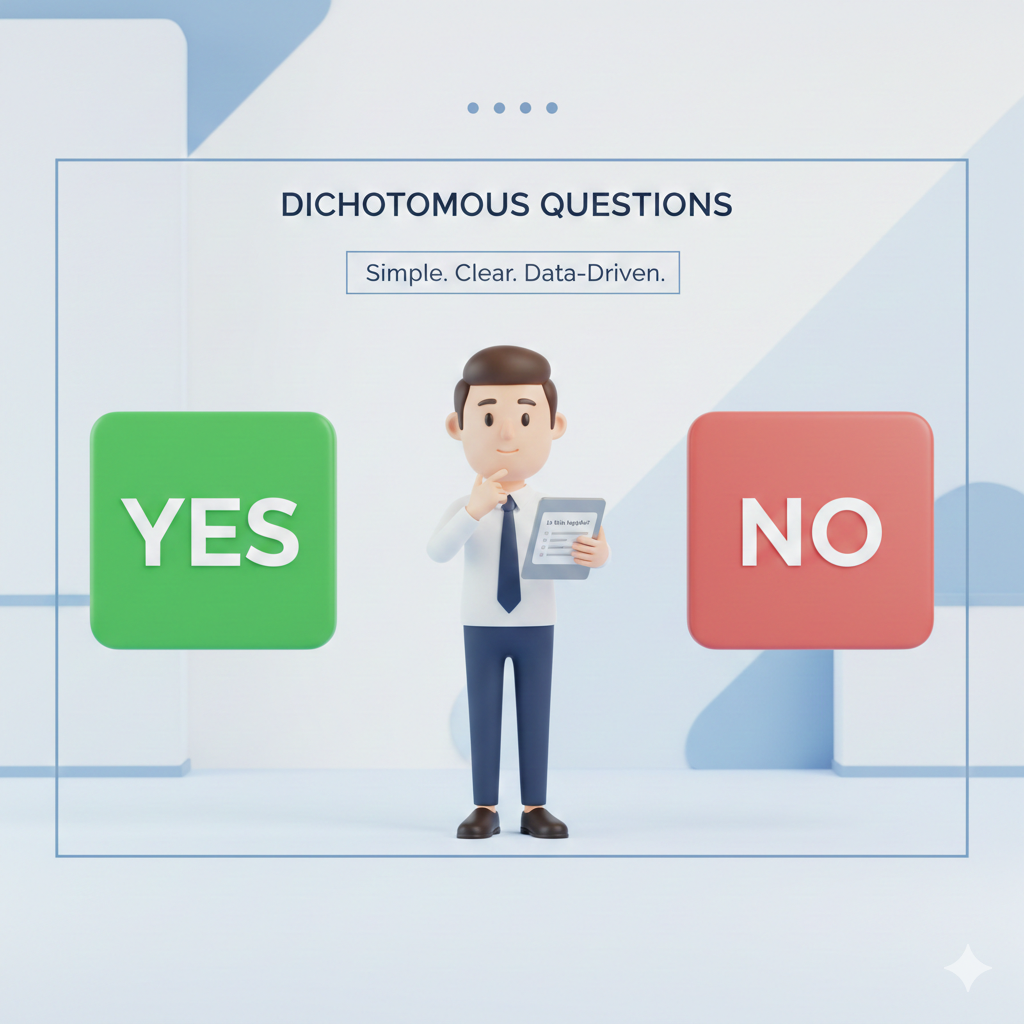
the world of data collection, sometimes less is more. While open-ended questions allow for deep storytelling, dichotomous questions are the “meat and potatoes” of survey design. They provide clarity, speed, and hard data that is easy to analyze.
Whether you are building a customer satisfaction survey or a quick poll for social media, understanding how to use these “Either/Or” questions is vital for getting high response rates.
What is a Dichotomous Question?
A dichotomous question is a closed-ended question that offers exactly two possible answers. These options are usually opposites or mutually exclusive. The most common examples include:
- Yes / No
- True / False
- Agree / Disagree
- Fair / Unfair
Because the respondent is forced to choose between two distinct paths, these questions eliminate “fence-sitting” and provide clear-cut statistics.
Top 10 Dichotomous Question Examples
To give you a better idea of how these function in the real world, here are various examples categorized by use case:
| Category | Question Example | Options |
| Customer Support | Was your issue resolved today? | Yes / No |
| Product Feedback | Have you used this feature before? | Yes / No |
| Market Research | Do you own a smartphone? | Yes / No |
| User Experience | Was the website easy to navigate? | Yes / No |
| Legal/Compliance | Do you accept the terms and conditions? | Agree / Disagree |
| Education | Is the Earth the third planet from the sun? | True / False |
| Lifestyle | Do you prefer working from home? | Yes / No |
| Health | Have you exercised in the last 24 hours? | Yes / No |
| Events | Will you be attending the gala? | Yes / No |
| E-commerce | Would you recommend us to a friend? | Yes / No |
The Pros and Cons of Going Dichotomous
The Advantages
- High Completion Rates: These questions are incredibly easy to answer. Respondents don’t have to think hard, which reduces “survey fatigue.”
- Simplified Analysis: You don’t need complex algorithms to understand the results. It’s a simple $50/50$ or $70/30$ split.
- Clarity: There is no “maybe” or “sometimes” to muddy the waters. You get a definitive pulse on a specific topic.
The Potential Pitfalls
- Lack of Nuance: Life isn’t always black and white. Forcing a “Yes” or “No” can frustrate users if their true answer lies in the middle.
- Risk of Bias: If a question is leading (e.g., “Don’t you agree that our service is great?”), it can skew your data.
Best Practices for Writing SEO-Friendly Questions
If you are designing these for an online quiz or a lead-generation form, keep these tips in mind:
- Keep it Short: The beauty of a dichotomous question is brevity.
- Stay Neutral: Avoid emotive language that pushes the user toward one answer.
- Use Visuals: For mobile users, big buttons for “Yes” and “No” improve the user experience (UX) significantly.
Pro Tip: Use dichotomous questions as “screening questions” at the start of a survey to disqualify participants who don’t fit your target demographic.
Transactional Content: Boost Your Data Today
Ready to stop guessing and start knowing? Collecting actionable insights shouldn’t be a chore. Our Premium Survey Template Pack includes over 50 pre-written dichotomous questions tailored for retail, SaaS, and healthcare industries.
- Fast Integration: Copy and paste into Typeform, SurveyMonkey, or Google Forms.
- Expertly Crafted: Designed by data scientists to minimize response bias.
- Instant Access: Download your toolkit now and launch your survey in under 5 minutes.
[Get the Survey Toolkit – $19.99]
Make better decisions with clearer data.
Leave a Reply