
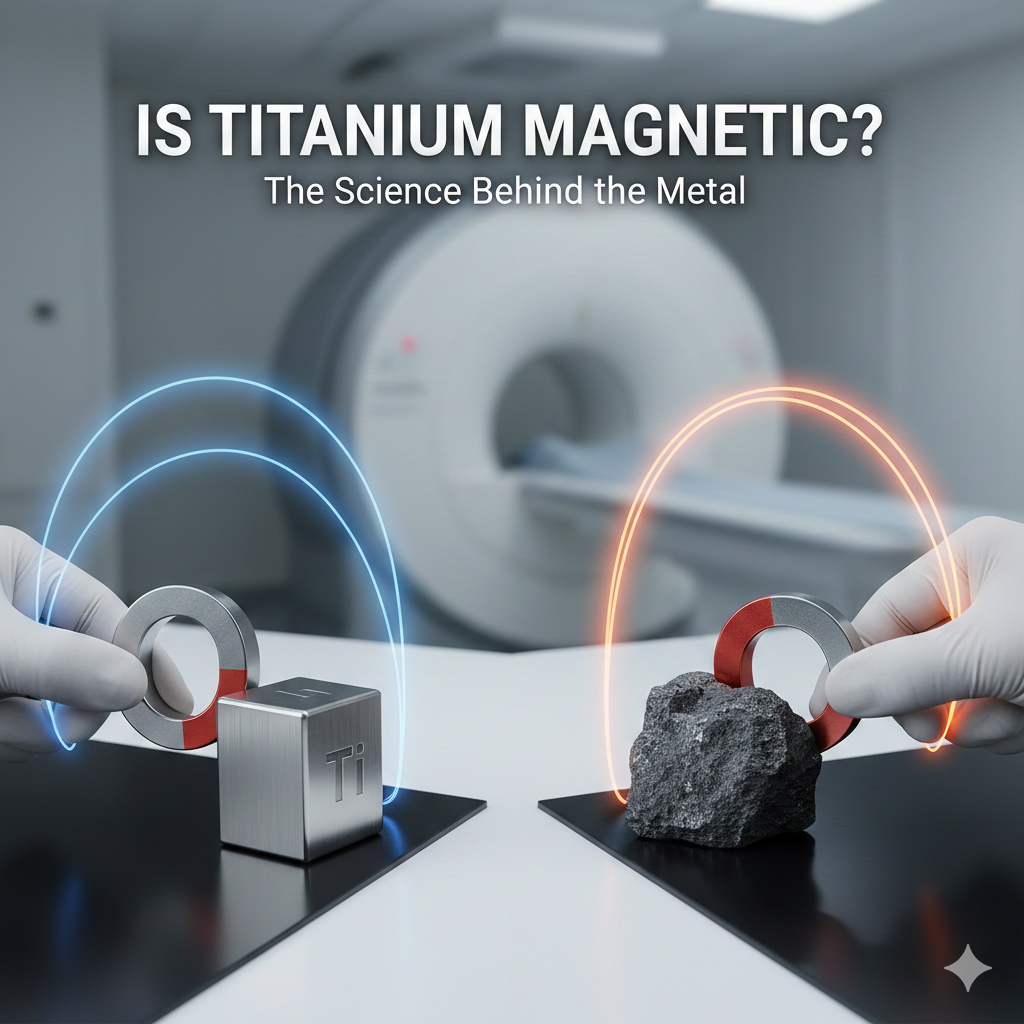
Titanium is often hailed as a “wonder metal.” From aerospace engineering and medical implants to high-end jewelry, its strength-to-weight ratio and corrosion resistance are legendary. However, one of the most common questions asked by hobbyists, jewelers, and patients heading into an MRI suite is: Is titanium magnetic?
The short answer is no, not in the way you might think. But the scientific reality is a bit more nuanced.
The Short Answer: Is Titanium Magnetic?
In everyday terms, titanium is non-magnetic. If you hold a high-powered neodymium magnet up to a piece of pure titanium, you won’t feel that familiar “snap” or pull that you experience with iron, nickel, or cobalt.
However, in the world of physics, titanium is classified as paramagnetic. This means it has a very weak attraction to magnetic fields—so weak that it is undetectable without sensitive laboratory equipment.
Why Titanium Isn’t “Magnetic” Like Iron
To understand why titanium behaves this way, we have to look at its atomic structure. Materials like iron are ferromagnetic. They have unpaired electrons that align their spins in the same direction, creating a strong, permanent magnetic field.
Titanium, on the other hand, lacks this alignment. While it does have some unpaired electrons, their magnetic moments don’t “cooperate” to create a significant pull.
Titanium and MRI Safety: A Critical Distinction
One of the most frequent reasons people search for titanium’s magnetic properties is related to medical procedures. If you have a titanium bone plate, screw, or dental implant, can you safely enter an MRI (Magnetic Resonance Imaging) machine?
Yes, titanium is considered “MRI compatible.” Because titanium is only weakly paramagnetic, it does not react violently to the powerful magnets inside an MRI machine. Unlike a steel fragment, which could be pulled through the body by an MRI’s magnetic field, a titanium implant stays securely in place.
- No Displacement: The magnet won’t tug on the implant.
- Minimal Heat: While some metals can heat up via induction, titanium’s conductivity is low enough that this is rarely an issue.
- Artifact Interference: Titanium does produce some “artifacts” (blurriness) on the actual scan image, but significantly less than stainless steel.
Does Titanium Stick to a Magnet? (The Magnet Test)
If you are trying to verify if a piece of jewelry or a car part is “real titanium,” many people reach for a magnet.
- If the magnet sticks: The item is not pure titanium. It is likely steel or has a high iron content.
- If the magnet does NOT stick: The item could be titanium, but it could also be aluminum, silver, or high-quality stainless steel (which can also be non-magnetic).
Pro Tip: The “magnet test” is a great way to rule out fakes, but it isn’t a definitive way to prove something is 100% titanium.
Magnetic Properties of Common Metals: A Comparison
To see where titanium sits in the spectrum of magnetism, let’s look at how it compares to other common materials.
| Metal | Type of Magnetism | Will it stick to a fridge magnet? |
| Iron | Ferromagnetic | Yes (Strongly) |
| Nickel | Ferromagnetic | Yes |
| Titanium | Paramagnetic | No |
| Aluminum | Paramagnetic | No |
| Copper | Diamagnetic | No |
| Gold | Diamagnetic | No |
Can Titanium Become Magnetic?
While pure titanium is non-magnetic, there are two specific scenarios where you might see magnetic-like behavior:
1. Titanium Alloys
Titanium is rarely used in its 100% pure form. It is often alloyed with other metals to increase its strength. If titanium is alloyed with a ferromagnetic material like iron or nickel, the resulting alloy might exhibit slight magnetic properties, though this is rare in medical-grade or aerospace-grade titanium (like Ti-6Al-4V).
2. The “Lenz’s Law” Effect
If you drop a strong magnet through a titanium tube, the magnet will slow down. This isn’t because the titanium is “attracting” the magnet. Instead, the moving magnetic field creates “eddy currents” in the titanium, which in turn create a temporary magnetic field that opposes the magnet’s motion.
Common Myths About Titanium
Myth: Titanium jewelry will set off airport metal detectors.
Truth: Usually, no. Because titanium is non-ferrous and most jewelry is relatively small, it rarely triggers the magnetic sensors in older metal detectors. However, modern high-sensitivity scanners might pick up the density of the metal.
Myth: You can’t get an MRI if you have titanium implants.
Truth: As discussed, titanium is the preferred metal for implants specifically because it is safe for MRI environments. Always inform your technician, but rest assured that titanium is the industry standard for safety.
Final Thoughts: Why the Lack of Magnetism Matters
The fact that titanium isn’t magnetic is actually one of its greatest strengths. It allows the metal to be used in sensitive electronic housing, medical devices, and high-tech research tools where magnetic interference would be a disaster.
Whether you are a patient concerned about an upcoming scan or a consumer checking the authenticity of a watch, understanding the paramagnetic nature of titanium gives you peace of mind. It is a metal that offers the strength of steel without the magnetic “baggage.”
Leave a Reply