When you dive into the world of optics, specifically the behavior of curved mirrors and lenses, you eventually hit a “sweet spot.” In physics diagrams, this spot is labeled C.
Whether you are a student prepping for an exam or a hobbyist curious about how your makeup mirror or telescope works, understanding what happens when an object is placed at C is fundamental. It is the point where physics feels almost poetic in its symmetry.
What Does “At C” Actually Mean?
In the study of spherical mirrors (concave and convex), C stands for the Center of Curvature.
Imagine a hollow glass sphere. If you cut a slice out of that sphere and silver it on one side, you have a mirror. The center of that original sphere is the Center of Curvature. The distance from this point to the mirror’s surface is the radius ($R$).
There is a specific relationship between the center of curvature and the focal point ($f$):
$$R = 2f$$
This means that when an object is at C, it is exactly twice as far from the mirror as the focal point.
The Magic of the Concave Mirror: Object at C
The concave (converging) mirror is where the most interesting things happen. When you move an object from infinity toward the mirror, the image changes size and position. But when the object lands exactly at C, the universe balances the scales.
The Characteristics of the Image:
- Position: The image is formed exactly at C.
- Size: The image is the same size as the object.
- Nature: It is a real and inverted image.
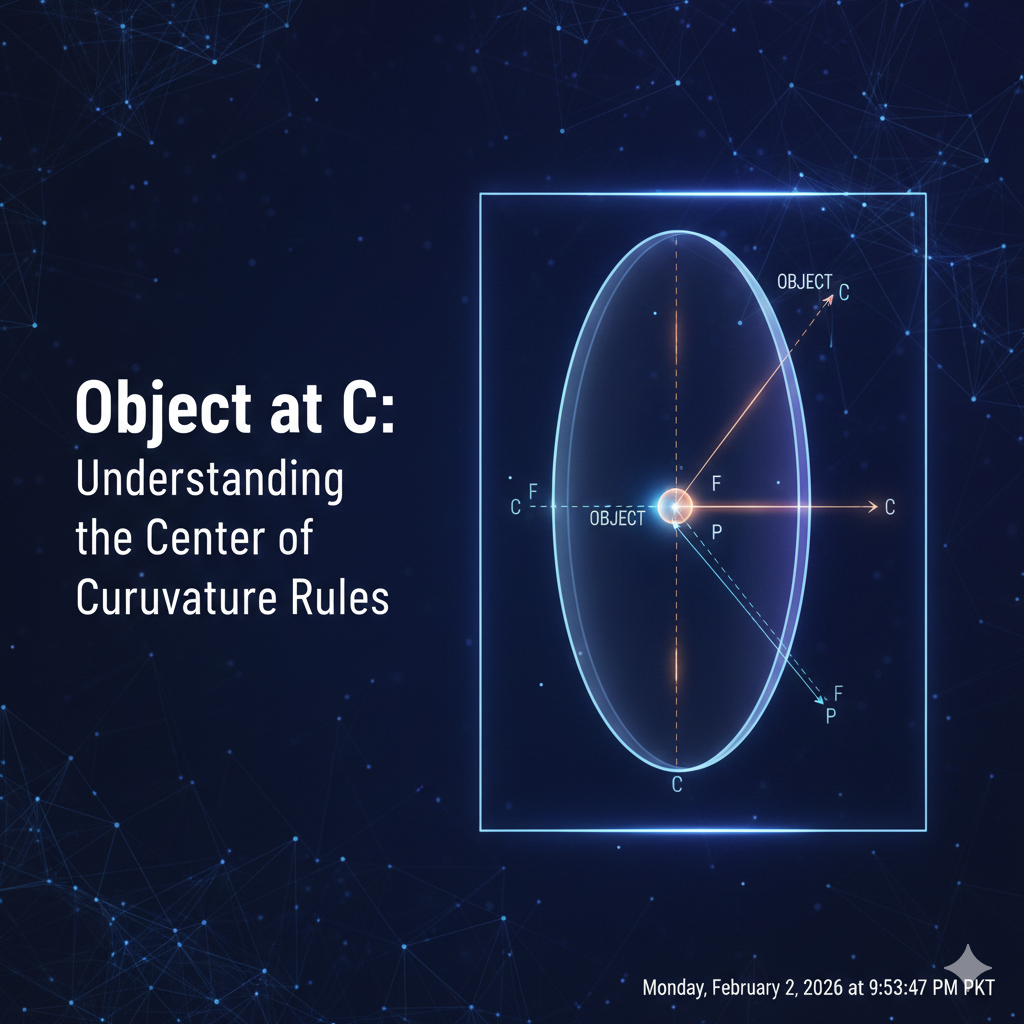
Why does this happen? In ray optics, a ray passing through the focus becomes parallel to the principal axis, and a ray that is parallel to the principal axis passes through the focus. At point C, these rays intersect precisely beneath the original object.
Key Questions About Objects at C
1. Why is the image inverted?
Because the light rays actually cross each other after reflecting off the mirror, the top of the object becomes the bottom of the image. Since the light rays truly meet, it is a “real” image—meaning if you placed a piece of paper at point C, the image would be projected onto it.
2. Does this happen with Convex Mirrors?
Strictly speaking, no. For a convex (diverging) mirror, the Center of Curvature is behind the mirror. Since you cannot place a physical object inside or behind a solid mirror, we don’t see this “same size” phenomenon. Convex mirrors always produce diminished, virtual images.
3. How does this apply to Lenses?
In thin lens physics, we often use 2F instead of C. When an object is placed at $2F_1$ of a convex lens, the image is formed at $2F_2$ on the other side. Just like the mirror, the image is real, inverted, and exactly the same size.
Ray Diagram: Visualizing the Path
To prove why the image forms this way, we use three standard rays:
- Ray 1: Travels parallel to the principal axis and reflects through the Focal Point ($F$).
- Ray 2: Passes through the Focal Point ($F$) and reflects parallel to the principal axis.
- Ray 3: (Optional) Passes through $C$ and reflects back on the same path.
When the object is at C, Ray 1 and Ray 2 will always meet at a point directly vertical to the object’s position at C.
Real-World Applications
While “Object at C” is a classic classroom problem, the principles of the Center of Curvature govern many technologies:
- Solar Cookers: While they usually aim for the Focus ($F$) to get maximum heat, understanding the C-point helps in designing the structural curve of the reflector.
- Ophthalmoscopes: Doctors use these to look into your eyes. The positioning of lenses and the patient’s eye often relies on these fixed geometric points to ensure a clear, 1:1 scale view of the retina.
- Telescope Calibration: Ensuring the primary mirror is perfectly spherical requires testing at the Center of Curvature to look for distortions.
Summary Table: Object at C (Concave Mirror)
| Feature | Description |
| Object Position | At C (Center of Curvature) |
| Image Position | At C |
| Size of Image | Equal to Object ($m = -1$) |
| Nature of Image | Real and Inverted |
| Magnification | Exactly 1 |
Conclusion
The “At C” position is the “Goldilocks zone” of optics—everything is perfectly centered, the math is clean, and the image perfectly mirrors the object’s proportions, albeit upside down. Understanding this point allows you to predict how light will behave in much more complex systems.
Leave a Reply