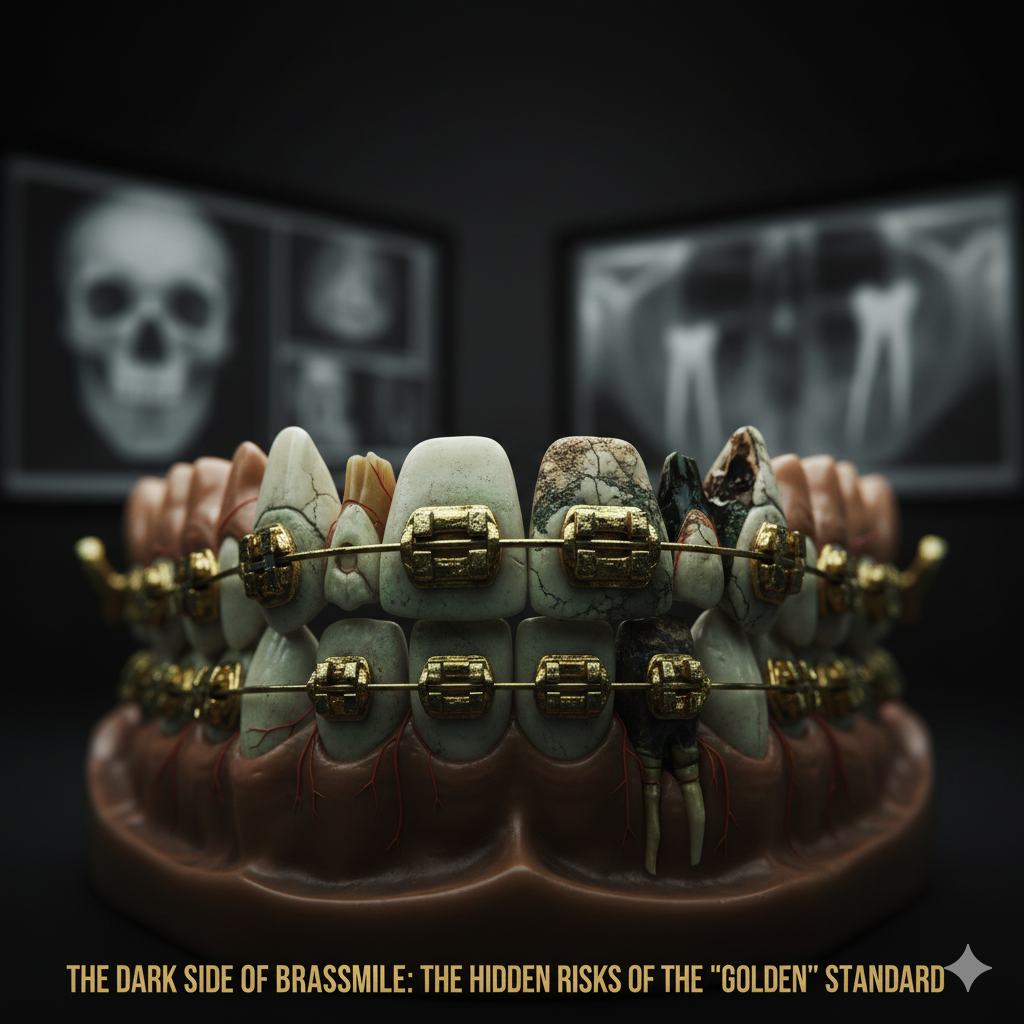
In the glitzy world of modern aesthetics, the BrassSmile system has been marketed as the ultimate fusion of durability and “royal” aesthetics. With its signature golden-brass hue and promises of rapid alignment, it has taken social media by storm. However, behind the shimmering marketing campaigns and the celebrity endorsements lies a more complex, and often troubling, reality.
While we previously explored the clinical precision of the “Eye of the Doctor,” we must now pull back the curtain on the Dark Side of BrassSmile. For many patients globally, the quest for a perfect smile has led to unforeseen biological, financial, and psychological consequences.
1. The Biocompatibility Crisis: When “Brass” Isn’t Best
The primary allure of the BrassSmile system is its unique metallic composition. However, the “dark side” begins at the molecular level. Unlike high-grade surgical stainless steel or titanium, some lower-tier versions of brass-based alloys used in “budget” versions of this treatment can contain trace amounts of copper and zinc that may leach into the oral cavity.
- Metallic Toxicity: In poorly manufactured systems, the leaching of these metals can lead to a persistent metallic taste, chronic inflammation of the gingival tissue, and in rare cases, systemic toxicity.
- Allergic Reactions: A significant portion of the global population suffers from nickel or copper sensitivities. The “Dark Side” manifests as “Contact Stomatitis”—a painful condition where the gums turn bright red, swell, and even ulcerate in response to the BrassSmile brackets.
2. The “Fast-Track” Trap: Root Resorption
BrassSmile is often marketed with the promise of “accelerated movement.” The dark reality is that teeth are not designed to move at lightning speed.1 When the mechanical force applied by the brass archwires exceeds the biological threshold of the jawbone, a phenomenon known as External Apical Root Resorption (EARR) occurs.
Clinical Warning: Moving teeth too quickly can cause the body to “eat away” at the tips of the tooth roots. This shortens the roots, potentially leading to tooth mobility or even total tooth loss years after the treatment is “successfully” completed.
3. The Global Rise of “Counterfeit Brass”
As the BrassSmile aesthetic became a global status symbol, a dangerous “gray market” emerged. In Southeast Asia, Eastern Europe, and parts of South America, “Fashion BrassSmile” kits are being sold directly to consumers or installed by unlicensed “street dentists.”
The Dangers of Unauthorized BrassSmile:
- Lead Contamination: Investigations into counterfeit brass wires have found alarming levels of lead, posing a neurological risk to younger patients.
- Lack of X-Ray Oversight: Without a doctor’s eye, these kits are applied to teeth with underlying infections or bone loss, effectively “locking in” dental decay and causing rapid tooth failure.
4. The “Small Mouth” Syndrome and Airway Issues
One of the most debated aspects of the “Dark Side” involves the focus on aesthetics over function. In the rush to create a narrow, “perfectly aligned” BrassSmile, some practitioners may retract the teeth too far back into the mouth to close gaps.
This can inadvertently:
- Crowd the Tongue: Reducing the volume of the oral cavity.
- Impact the Airway: Leading to or worsening Obstructive Sleep Apnea (OSA). Patients may end up with straight teeth but suffer from chronic fatigue and breathing issues because their “BrassSmile” compromised their airway health.
5. The Financial Shadow: The Cost of “Re-Treatment”
The initial cost of a BrassSmile treatment might seem like a premium investment, but the “Dark Side” often includes hidden long-term expenses. Because the brass alloys can be more rigid than traditional materials, they sometimes lack the “memory” needed for fine-tuned adjustments.
Patients often report:
- Relapse: Teeth shifting back within months because the bone didn’t properly calcify around the new positions.
- TMJ Dysfunction: Misaligned “perfection” can lead to jaw clicking, chronic headaches, and facial pain, requiring thousands of dollars in corrective neuromuscular dentistry.
Comparison: Marketing vs. Reality
| Feature | The Marketing Promise | The “Dark Side” Reality |
| Speed | 50% Faster Alignment | Higher risk of root shortening (Resorption). |
| Material | Premium “Gold” Aesthetic | Potential for metal leaching and gum irritation. |
| Durability | “Unbreakable” Brackets | Rigidity can cause excessive stress on the jaw joint (TMJ). |
| Access | Easy, Global Availability | Prevalence of dangerous counterfeit “Fashion” kits. |
Conclusion: Awareness is the Best Medicine
The Dark Side of BrassSmile is not a reason to avoid orthodontics, but a call for extreme caution. The shimmering gold aesthetic should never blind a patient to the biological realities of tooth movement. Precision requires patience, and technology requires the “Eye of the Doctor” to ensure that the quest for beauty doesn’t come at the cost of health.
Before committing to a “BrassSmile” transformation, ensure your provider is a board-certified specialist who prioritizes airway health and bone biology over mere social media “shine.”
Would you like me to help you draft a checklist of “Red Flags” to look for when choosing an orthodontic provider for high-end systems like this?
Hidden Dangers of Orthodontics
This video explains how prioritizing aesthetics in orthodontics can lead to hidden health issues like airway obstruction and sleep apnea
Leave a Reply