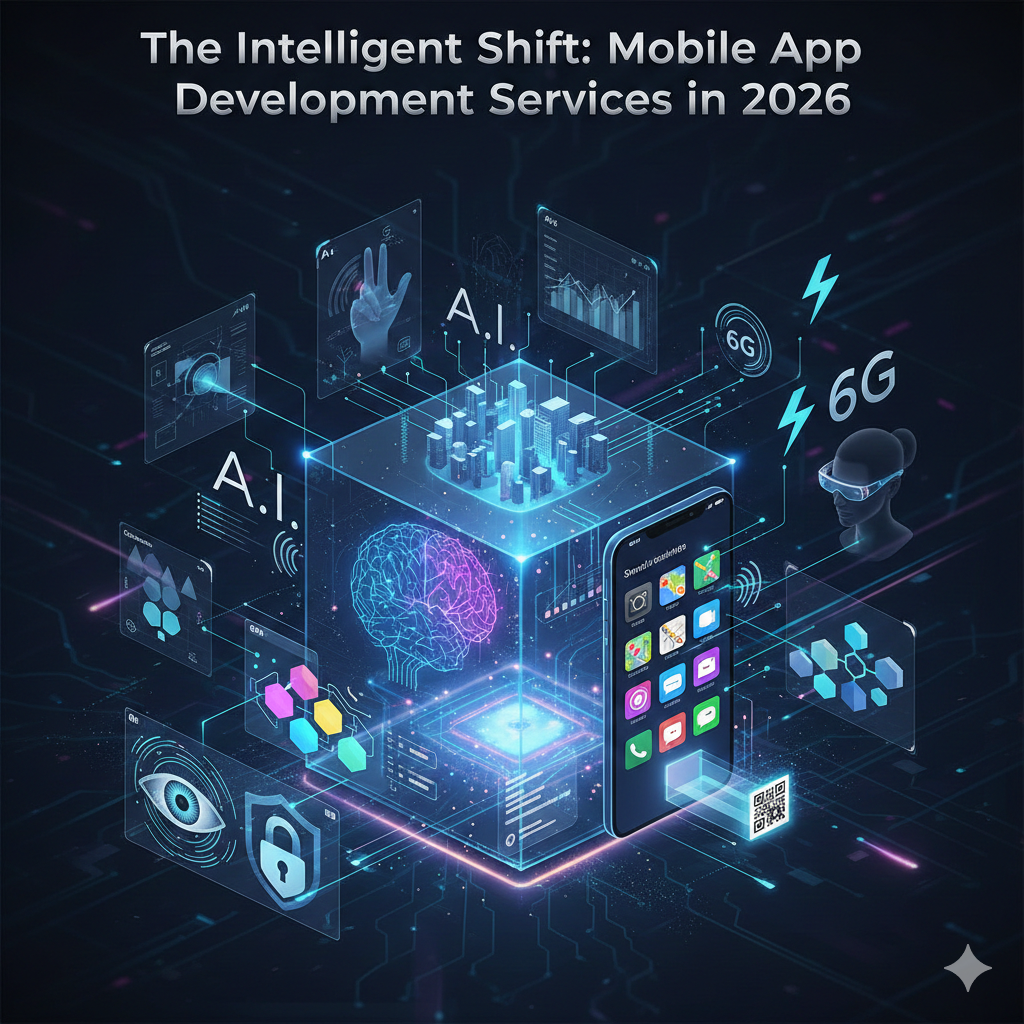
The year 2026 marks a historic turning point in the digital world. Mobile applications have evolved from being mere tools on a screen to becoming proactive, intelligent companions. For businesses and entrepreneurs, “mobile app development services” no longer just means writing code; it means architecting sophisticated ecosystems that blend artificial intelligence, spatial computing, and ultra-fast connectivity.
If you are looking to stay competitive, here is the definitive landscape of mobile app development services in 2026.
1. The Era of AI-Native Development
In 2026, AI is no longer a “plugin” or an optional feature—it is the bedrock. Modern services now focus on Agentic AI, where apps don’t just wait for a command but autonomously complete tasks.
- Predictive Intent: Apps now analyze user behavior in real-time to anticipate the next move. A travel app doesn’t just show flights; it suggests a booking because it “knows” you have a recurring meeting in London.
- On-Device Machine Learning (Edge AI): Privacy concerns and the need for speed have shifted processing from the cloud to the device. Development services now prioritize local models that offer zero-latency responses while keeping sensitive data offline.
2. Spatial Computing and Extended Reality (XR)
With the maturity of hardware like the Apple Vision Pro and advanced AR-enabled glasses, mobile app development has moved beyond the “flat” screen.
- Immersive Commerce: Retail apps now offer full-scale 3D product try-ons where surface geometry and lighting are perfectly synced with the real world.
- Spatial Interfaces: Developers are moving away from traditional buttons toward multimodal interactions—gestures, gaze tracking, and voice commands.
3. The Dominance of 5G-Native and Early 6G Services
By 2026, 5G is the global standard, and the conversation has already shifted toward 6G integration. Mobile app development services are leveraging this bandwidth to build “thin” apps:
- Cloud Streaming: Heavy processing for gaming or complex 3D rendering happens on the server, while the mobile device acts as a high-fidelity display.
- Massive IoT: Apps can now manage hundreds of connected devices simultaneously without lag, turning the smartphone into a universal remote for smart cities and automated homes.
4. Low-Code and AI-Augmented Engineering
The way apps are built has fundamentally changed. Gartner reports that by 2026, 75% of new application development will use low-code tools.
- Speed to Market: Professional services now use AI “copilots” to generate boilerplate code, conduct automated QA testing, and manage DevOps pipelines.
- Validation-First Approach: Instead of 6-month build cycles, services now focus on 4-week “Sprint MVPs” where ideas are validated with real users through rapid prototyping.
5. Security: From “Add-on” to “Zero Trust”
As cyber threats become more sophisticated in 2026, security services have become more rigorous.
- Biometric-Only Authentication: Passwords are a relic. Modern apps use continuous biometric monitoring (gait analysis, facial micro-expressions) to ensure the user is who they claim to be.
- Blockchain for Data Integrity: Many financial and healthcare apps now use decentralized ledgers to ensure that user records are immutable and transparent.
6. Super Apps and Micro-Experiences
The “one app for one task” model is fading. In 2026, the market is split between:
- Super Apps: All-in-one ecosystems (like WeChat but for Western markets) that handle payments, messaging, and shopping in one place.
- Instant Apps: Zero-download experiences that allow users to access a specific feature (like paying for parking) instantly via a QR code or NFC tap without installing a full app.
Key Industry Statistics for 2026
| Metric | 2026 Projection |
| Global Mobile Users | 7.5 Billion |
| Enterprise AI Adoption | 80% of apps will feature GenAI |
| Cross-Platform Market | 46% of developers prefer Flutter/React Native |
| 5G Traffic Share | 84% of total mobile data |
Conclusion: Choosing the Right Partner in 2026
Mobile app development services in 2026 require a partner who understands that an app is no longer a destination—it’s an experience. Success today is defined by personalization, speed, and trust. Whether you are a startup looking to disrupt the market or an enterprise seeking digital transformation, your focus should be on building “Intelligent Architecture” rather than just a “Mobile Interface.”
Leave a Reply