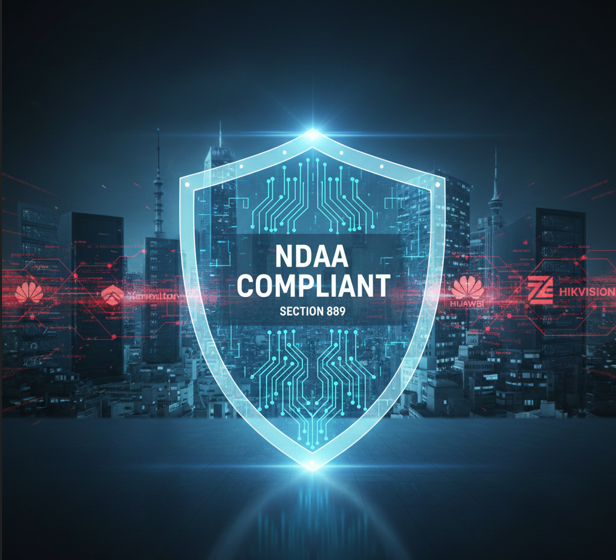
At its core, the National Defense Authorization Act (NDAA) is a United States federal law passed annually to outline the budget and expenditures of the Department of Defense.2 However, the term “NDAA Compliant” specifically gained prominence following the John S. McCain NDAA for Fiscal Year 2019, particularly Section 889.
This specific section prohibits federal agencies, their contractors, and recipients of federal grants or loans from procuring or using “covered” telecommunications and video surveillance equipment from specific foreign companies.3 Compliance means that a product—and all its essential components—is free from hardware and software manufactured by these restricted entities.4+1
The Restricted List: Who Is Not Compliant?
The ban focuses on several major Chinese manufacturers and their subsidiaries, including:5
- Huawei Technologies Company6
- ZTE Corporation7
- Hytera Communications Corporation8
- Hangzhou Hikvision Digital Technology Company9
- Dahua Technology Company10
Compliance isn’t just about the brand name on the box.11 It extends to the “guts” of the machine.12 If a camera is sold under a reputable American brand but uses a chipset manufactured by Hikvision or HiSilicon (a Huawei subsidiary), that device is not NDAA compliant.13+2
Why Intentional Compliance Matters for Your Business
While the law technically applies to federal entities, the ripple effect has reached the private sector. Whether you are a small business owner or a security integrator, the intent behind choosing NDAA-compliant gear is rooted in three pillars: Security, Legality, and Longevity.
1. Eliminating “Backdoor” Vulnerabilities14
The primary intent of the NDAA is to mitigate national security risks, specifically the threat of espionage and cyberattacks.15 Non-compliant equipment is often flagged for having potential “backdoors” that could allow foreign entities to access sensitive data, monitor video feeds, or compromise an entire network.16 By choosing compliant hardware, you are ensuring that your security system isn’t the weakest link in your cybersecurity chain.17+2
2. Protecting Federal Funding and Contracts
For many organizations, non-compliance is a financial death sentence. If your business receives federal grants (common in healthcare and education) or bids on government contracts, using banned equipment can lead to the immediate termination of funding or disqualification from future opportunities.18 Even if you aren’t a direct contractor, a prime contractor might require you to be compliant as part of their supply chain audit.19+1
3. Future-Proofing Your Investment
Technology is expensive. Installing a fleet of non-compliant cameras today might save a few dollars upfront, but if local regulations tighten or your business grows into a sector that requires federal compliance, you could be forced to rip out and replace your entire system.20 Choosing NDAA-compliant equipment is a strategic move to ensure your hardware remains viable for years to come.21+1
Navigating the Supply Chain: How to Verify Compliance
Verifying that a product is truly NDAA compliant requires more than just a quick glance at a spec sheet. Because of the complex nature of global manufacturing, many products are “white-labeled,” meaning they are made by one company and sold under another.
| Component Check | What to Look For |
| The SoC (System on Chip) | Ensure the main processor is not from HiSilicon or other banned entities. |
| Firmware & Software | Verify that the code running the device wasn’t developed by a restricted manufacturer. |
| Manufacturer Affiliation | Check if the brand is a subsidiary or “rebranded” version of a banned company. |
| Country of Origin | While not the only factor, products made in the US or allied nations (TAA compliant) are often a safer bet. |
The Broader Impact: A New Standard of Trust
The shift toward NDAA compliance is fundamentally changing the security industry. It has fostered a more transparent supply chain where manufacturers must be open about where their parts are sourced.22 For the end-user, this translates to a higher standard of quality and trust.23 When you see the “NDAA Compliant” badge, you aren’t just seeing a legal certification; you are seeing a commitment to data integrity and ethical sourcing.24+2
Industry Adoption Beyond the US
Interestingly, the influence of the NDAA has crossed borders. Many international firms in Europe and Asia are now requesting NDAA-compliant products because they serve global clients or simply want to adhere to the highest available security standards. In 2025 and beyond, being NDAA compliant is becoming a universal shorthand for “enterprise-grade security.”
Conclusion: Securing the Future Today
The world of security is no longer just about locks and keys; it’s about bits and bytes. Understanding what it means to be NDAA compliant allows you to make informed, intent-full decisions that protect your organization’s data, reputation, and financial health.25 While the regulatory landscape can be complex, the goal is simple: building a technological ecosystem that is transparent, secure, and resilient against global threats.
Leave a Reply