
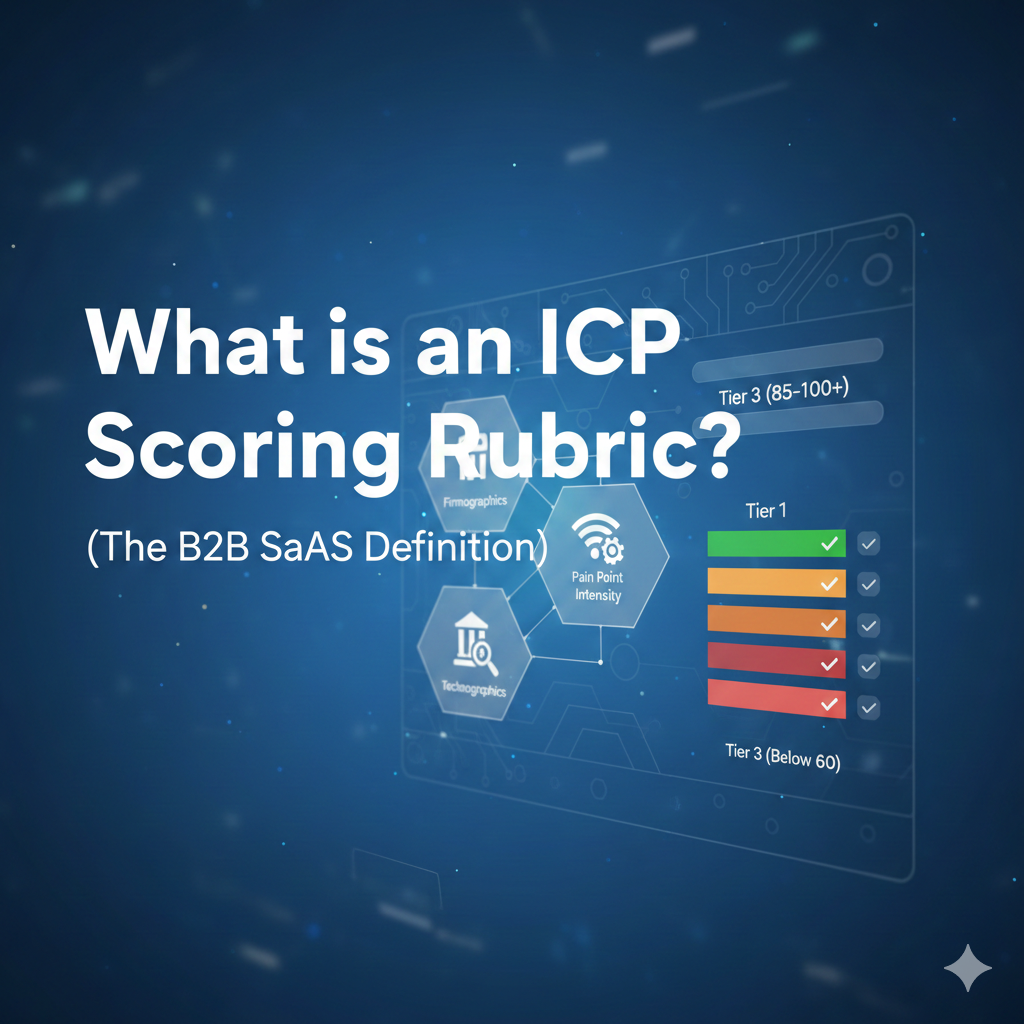
An ICP scoring rubric b2b saas definition refers to a weighted, quantitative framework used to evaluate how closely a prospective account matches your “Ideal Customer Profile.” Unlike basic lead scoring (which often tracks individual behavior like email clicks), ICP scoring focuses on the firmographic, technographic, and environmental health of the entire organization.+1
In the SaaS context, a rubric assigns numerical values (e.g., 1–10) to specific company attributes. The goal is to produce a “Fit Score” that tells your team whether a prospect is a “Tier 1” (perfect match), “Tier 2” (strong potential), or “Tier 3” (out of profile).
Why the “Rubric” Approach Matters
In B2B, you aren’t just selling to a person; you’re selling to a business ecosystem. A rubric prevents “gut-feeling” sales by forcing teams to grade accounts against objective criteria such as:
- Firmographics: Revenue, employee count, and industry.
- Technographics: Their existing tech stack (e.g., do they use Salesforce or HubSpot?).
- Pain Point Intensity: How urgent is the problem your SaaS solves for their specific niche?
How to Build Your ICP Scoring Rubric: A 3-Step Framework
Creating a rubric requires more than just a spreadsheet; it requires alignment between Sales, Marketing, and Customer Success.
1. Identify “Super-User” Commonality
Before you can score a prospect, you must look at your best current customers. Analyze the top 10% of your accounts—those with the highest Lifetime Value (LTV) and lowest churn.
- The Keyword Lens: Define your icp scoring rubric b2b saas definition by looking at the “signals” these super-users emitted before they signed. Did they all have a certain number of employees? Were they in a specific funding round?
2. Weight Your Attributes
Not all criteria are created equal. In a B2B SaaS rubric, “Industry” might be a 10-point factor, while “Geography” might only be worth 2 points.
Pro Tip: Use a “Negative Scoring” system. If a company is in an industry you cannot legally serve or don’t have features for, give them a score of -100 to immediately disqualify them.
3. Create the Scoring Tiers
Once you’ve assigned points, group the totals into actionable tiers: | Score Range | Tier | Action Item | | :— | :— | :— | | 85–100 | Tier 1 (Gold) | Immediate SDR outreach; high-budget ABM campaigns. | | 60–84 | Tier 2 (Silver) | Automated nurturing; semi-personalized outreach. | | Below 60 | Tier 3 (Bronze) | Low-touch marketing; “No-Go” for active sales. |
The Strategic Impact: From Informational to Transactional
Understanding the icp scoring rubric b2b saas definition is purely informational until you apply it to your pipeline. When implemented correctly, the rubric shifts your business from a passive “wait and see” approach to a transactional powerhouse.
Shorter Sales Cycles
When your sales reps only speak to Tier 1 accounts, the “Need” and “Budget” are already validated by the rubric. This removes the friction of educating a prospect who was never a fit in the first place.
Marketing ROI and CAC Reduction
Marketing teams can stop spending budget on broad LinkedIn ads. Instead, they can feed the ICP scoring rubric into their ad platforms to target only the high-scoring accounts, significantly lowering your Customer Acquisition Cost (CAC).
Better Product-Market Fit
The rubric provides a feedback loop for the Product team. If you notice that accounts using a specific competitor (a technographic signal) score high but have a low close rate, it reveals a feature gap that needs to be filled to win that segment.
Final Thoughts: The Rubric is Not Static
In the fast-paced SaaS world, your ideal customer today might not be your ideal customer next year. Maybe you’ve moved up-market from SMB to Enterprise, or perhaps a new integration has opened up a whole new industry.
A successful ICP scoring rubric b2b saas definition is a living document. You should revisit your scoring weights every quarter to ensure they still correlate with high retention and high LTV.
Ready to stop chasing the wrong leads? The first step toward efficient growth is moving from a “guesswork” profile to a “data-driven” rubric. By quantifying what makes a customer “ideal,” you empower your entire organization to focus on the accounts that actually move the needle.
Leave a Reply